8 April 2026 · 9 min read
Can You Have a Veranda in a Small Garden? (Yes — Here’s How)
Your garden doesn’t need to be big. It just needs to be covered.
It’s one of the most common things we hear: “I’d love a veranda, but my garden’s too small.” We hear it from people with terraced houses, from people with new-build gardens, from people who can see their back fence from the kitchen window without squinting. And in almost every case, they’re wrong.
A small garden isn’t a problem for a veranda. In many ways, it’s the ideal situation. Here’s why — and exactly how to make it work, with real sizes and real prices.
The Small Garden Advantage
Here’s something that sounds counterintuitive but is absolutely true: a veranda transforms a small garden more than it transforms a large one.
Think about how you actually use a small garden. On a good day — dry, not too cold, not too hot, no wind — you might sit out there. In the UK, that gives you roughly 30 to 40 genuinely comfortable outdoor days per year. The rest of the time, you look at your garden through a window.
A veranda changes that equation completely. Under cover, you’re protected from rain, shielded from wind, and shaded from the worst of the sun. Suddenly your outdoor space is usable from March to November without hesitation — and on plenty of dry winter days too. You go from 30 usable days to 250 or more. That’s not a marginal improvement. That’s turning a space you barely use into one you use almost every day. We explore the full range of possibilities in our guide to using your veranda year-round.
In a large garden, a veranda is a nice addition. In a small garden, it can genuinely double the amount of time you spend outdoors. The smaller the garden, the bigger the proportional impact.
How Small Is Too Small? A Practical Sizing Guide
Let’s get specific. Below is a guide to veranda sizes, what they’re realistically good for, and what they cost. All prices include installation and VAT.
| Size (W × D) | What It Fits | Polycarbonate Roof | Glass Roof |
|---|---|---|---|
| 2m × 1m | Doorway shelter — step out without getting rained on, store boots | From ~£2,600 | — |
| 4m × 2.5m | Bistro set for two, compact two-seater sofa, morning coffee spot | From ~£3,100 | From ~£4,400 |
| 4m × 3m | Table and chairs for four, comfortable lounge seating | From ~£3,300 | From ~£4,800 |
| 5m × 3m | Dining for six, sofa set with coffee table, proper entertaining space | From ~£4,100 | From ~£5,300 |
The smallest veranda we install — a 2m × 1m doorway canopy — is barely bigger than an open umbrella. But it keeps the rain off your back door, stops water pooling on the threshold, and gives you somewhere to leave muddy boots. At under £3,000 installed, it’s one of the most cost-effective improvements you can make to a small home.
The sweet spot for most small gardens is the 4m × 2.5m or 4m × 3m size. That’s wide enough to span most of the back of a terraced or semi-detached house, and deep enough for a proper seating area. You’re looking at the Bolthole at the entry level or the Haven if you want British engineering and a 60-year lifespan.
A note on “from” prices: These are genuine starting prices for each size. Your final quote depends on the model, roof material, colour choices, and any side options. Our online quoter gives you an accurate price for your exact specification in under two minutes — no phone call required.
The Depth Question: How Much Garden Should You Cover?
This is where people often overthink things. The rule of thumb is simple: your veranda should cover no more than half the total depth of your garden. This keeps the proportions right and leaves enough open sky to feel like an outdoor space rather than an enclosed room.
In practice, this works out neatly for most small gardens:
- 6m deep garden: Up to 3m veranda depth — leaves 3m of open garden
- 8m deep garden: Up to 4m veranda depth — leaves 4m for lawn, planting, or kids to play
- 10m deep garden: Up to 5m veranda depth — generous covered space plus plenty of garden
If your garden is only 4m or 5m deep, a veranda depth of 2m to 2.5m keeps everything in proportion. That’s still enough for a small dining table or a pair of comfortable lounge chairs.
Don’t think of the veranda as reducing your garden. Think of it as converting a portion of unusable-most-of-the-year space into usable-almost-every-day space. You’re not losing garden — you’re gaining living area.
Very shallow gardens (under 4m) can still work. A 1m or 1.5m depth veranda acts as a generous covered threshold — somewhere to sit in a chair on a rainy evening, somewhere to eat breakfast outside before work. It won’t fit a dining table, but it will fundamentally change how you interact with your outdoor space.
Five Ways to Make a Small Veranda Feel Bigger
The physical footprint of your veranda is fixed. But how spacious it feels is something you can control through smart design choices. Here’s what actually makes a difference:
1. Choose Glass Over Polycarbonate
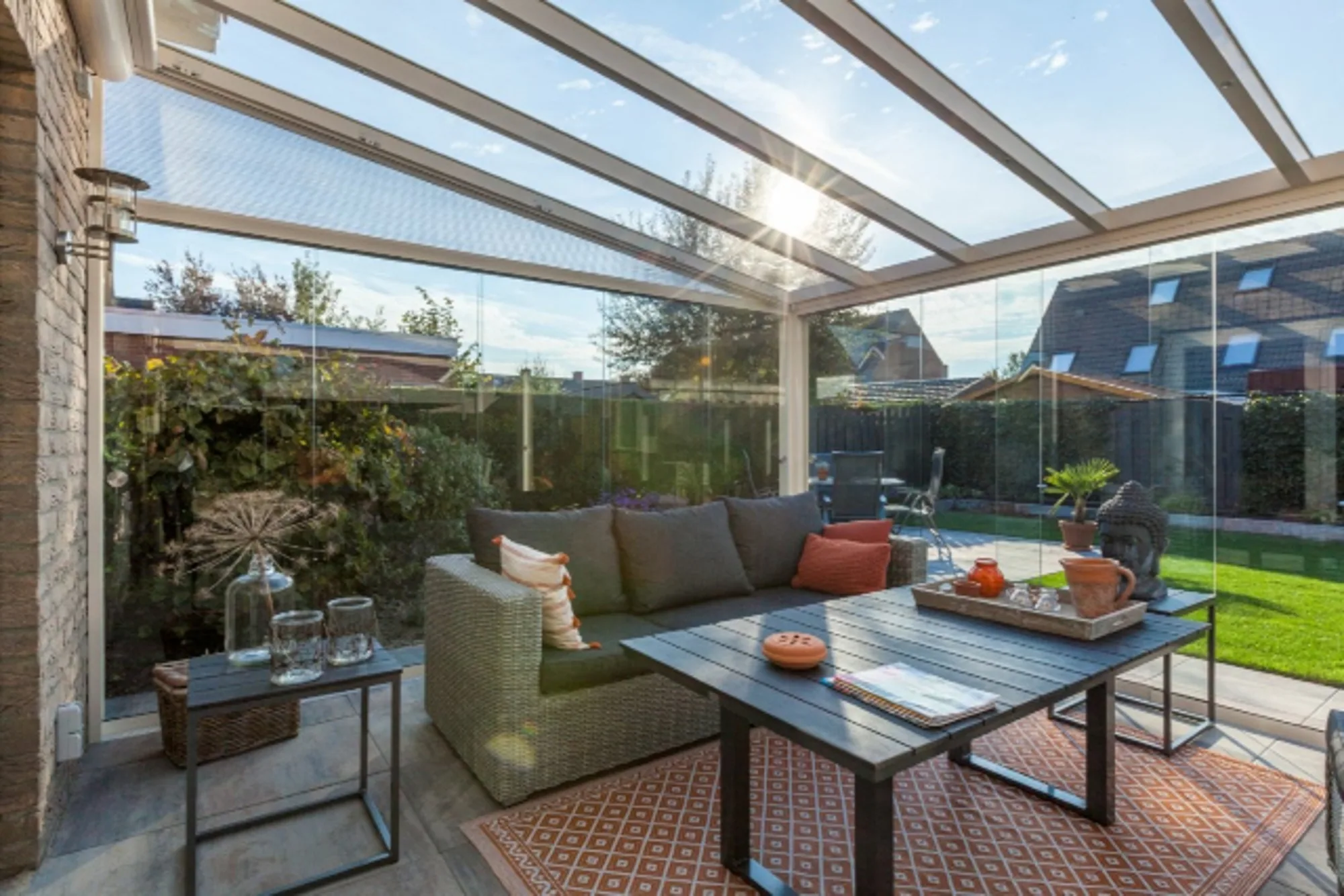
This is the single biggest impact decision for a small veranda. A glass roof lets natural light flood through, so the space beneath feels open and airy rather than enclosed. Polycarbonate is lighter, cheaper, and perfectly functional — but it diffuses the light and can make a compact space feel more like sitting under a shelter. Glass makes it feel like sitting outside with an invisible umbrella above you.
The cost difference is meaningful but not enormous. For a 4m × 3m veranda, you’re looking at roughly £1,500 more for glass. On a space you’ll use for decades, it’s often worth the investment — especially in a small garden where the sense of openness matters most.
2. Keep the Sides Open
The temptation in a small garden is to enclose the veranda for maximum weather protection. Resist it — at least initially. Open sides maintain the connection between the covered space and the garden beyond, making both feel larger. The veranda feels like part of the garden rather than a box within it.
If you find you want wind protection later, you can always add side panels down the line. Starting open and adding sides is easy. Starting enclosed and removing them later is a waste of money.
3. Use the Full Width of the House
A narrow veranda on a wide house looks like an afterthought. A veranda that spans the full width of the rear wall — even if it’s only 2m deep — looks intentional and architectural. It creates a proper threshold between inside and out, and it means every room that faces the garden benefits from the cover.
4. Choose the Right Furniture
Oversized rattan corner sofas are not your friend in a 4m × 2.5m veranda. Think bistro sets, slim-profile chairs, a compact two-seater with a side table. Stackable or foldable furniture lets you reconfigure for different occasions — two chairs and a book on a weekday morning, a table for four when friends come over.
5. Add Lighting
This is the one people forget, and it makes an enormous difference. Festoon lights, recessed LED spots in the veranda frame, or a simple plug-in lamp transform a small veranda into somewhere you actually want to sit after dark. Without lighting, your covered space is only usable during daylight hours. With it, summer evenings extend to 11pm and winter evenings start at 4pm.
Veranda vs Garden Room: Which Is Better for a Small Garden?
Garden rooms have had a surge in popularity since 2020, and they’re genuinely useful in the right situation. But in a small garden, a veranda and a garden room are solving very different problems — and one is almost always the better choice.
Veranda
Extends your home — steps directly from your back door
Open to the garden — preserves the outdoor feeling
Doesn’t consume garden floor area (attached to house wall)
Usable 250+ days per year
From ~£2,600 installed
No foundations or building regs needed
Garden Room
Separate building at the end of the garden
Fully enclosed — indoor environment
Takes up significant garden floor area
Usable 365 days (with heating/insulation)
Typically £15,000–£30,000+
May need foundations, possibly building regs
A garden room works well if you need a dedicated home office or a separate functional room — somewhere with a door you can close, heating you can control, and walls that block out the kids. But in a small garden, it has a fundamental problem: it takes up a huge proportion of your outdoor space. A 3m × 3m garden room in a 6m × 8m garden occupies nearly 20% of the total area. Add the path to reach it, and you’ve lost a quarter of your garden.
A veranda doesn’t have this problem. It attaches to the back of your house, so it extends your living space without consuming the garden. The open area in front of the veranda is still garden — it’s just now framed by a covered space that makes the whole thing feel more intentional and usable.
For small gardens, a veranda is almost always the smarter choice unless you specifically need an enclosed, heated workspace.
Three Real Small Gardens, Three Real Solutions
Abstract advice is only useful up to a point. Here are three real-world scenarios we see regularly — the kinds of gardens our customers actually have.
The Terraced House: 5m × 8m Garden
Classic Victorian terrace, narrow but reasonably deep
The garden is 5m wide (the full width of the house) and 8m deep to the back wall. Currently there’s a small patio, a strip of lawn, and a shed at the far end. The back door opens straight onto the patio with no cover at all.
The solution: A 5m × 3m Haven veranda with a glass roof, spanning the full width of the house. This covers the existing patio area and extends it by about a metre. The remaining 5m of garden stays open for the lawn and the kids to play on.
The cost: Around £5,300–£6,500 depending on colour and specification.
The result: The family goes from eating outside on the ten days a year it’s warm enough and dry enough, to eating outside from April to October without checking the weather forecast. The glass roof means the kitchen stays bright. The open sides mean the garden still feels its full size.
Key insight: Spanning the full 5m width is what makes this work. A 3m-wide veranda on a 5m house would look like an afterthought. Using the full width creates architectural coherence and maximises the usable covered area.
The Semi-Detached: 4m × 10m Garden
1930s semi, narrower garden but decent length
The garden is only 4m wide but extends 10m back. There’s room for a veranda, but the narrow width means furniture layout needs thought. Currently the patio is a 4m × 2m concrete slab that’s too small for a proper table.
The solution: A 4m × 3m Bolthole veranda with a polycarbonate roof. The full 4m width covers the entire back of the house, and the 3m depth provides space for a table for four with room to move around it.
The cost: Around £3,300–£3,800 with polycarbonate.
The result: The covered space is bigger than the old patio, usable in the rain, and cost less than a single family holiday. Seven metres of open garden remains beyond it. The couple added festoon lighting within the first month and now eat outside four or five nights a week from spring to autumn.
Key insight: Starting with polycarbonate keeps the budget low and the installation simple. If they want to upgrade to glass or add side panels later, both options remain open. Starting simple doesn’t mean staying simple.
The Cottage: 6m × 6m Garden
Small but square, every metre counts
A compact square garden that currently feels too small for much beyond a small lawn and a couple of planters. The owners assumed a veranda would make it feel even smaller.
The solution: A 5m × 2.5m Haven with a glass roof and open sides. The 2.5m depth keeps well within the “half the garden” guideline, while the 5m width stretches beyond the house wall to create a generous covered terrace. A low hedge along the veranda’s front edge softens the transition to the remaining 3.5m of open garden.
The cost: Around £4,800–£5,800 with glass.
The result: The owners say the garden feels bigger, not smaller. The covered zone gives the space structure — a defined “room” that leads into an open garden area. Before, the garden was a featureless square they looked at from inside. Now it has zones, purpose, and they use it almost daily.
Key insight: In a square garden, the glass roof is essential. It lets you see the sky, keeps the light flooding through to the house, and prevents the covered area from feeling like a box. The open sides are equally important — enclosing this veranda would make the garden feel half its size.
The Property Value Angle: Small Gardens Benefit Most
Here’s something estate agents will tell you: the biggest complaint buyers have about small-garden properties is that the outdoor space feels unusable. A veranda directly addresses that concern. It turns “the garden’s a bit small” into “there’s a lovely covered outdoor area.”
Nationwide Building Society research shows that a 10% increase in usable floor area can add up to 5% to a property’s value. A veranda doesn’t technically add floor area in the conveyancing sense, but it adds usable living space — and that’s what buyers respond to. On a £250,000 terraced house, even a conservative 3–4% uplift represents £7,500–£10,000 in added value. That’s more than the cost of most small verandas.
Crucially, the impact is proportionally greater on smaller properties. A veranda on a house with a large garden is a nice feature. A veranda on a house with a small garden is a selling point — it solves the single biggest objection a buyer would otherwise have. You can explore the numbers for your own property with our veranda value calculator.
The maths often works like this: a £3,000–£5,000 veranda on a small-garden property can add £7,500–£10,000 in value — while also giving you years of daily use before you ever sell. It’s one of the few home improvements where you genuinely get more back than you put in.
Start Simple, Add Later
One of the best things about a veranda — and something that makes it particularly well-suited to small gardens and smaller budgets — is that it’s modular. You don’t have to do everything at once.
A sensible approach for a small garden:
- Start with the frame and roof. This is the core investment — the structure that transforms your space. Choose your size, choose polycarbonate or glass, and get it installed.
- Live with it for a season. See how you actually use the space. Notice where the wind comes from. See which evenings you wish you had a side panel.
- Add sides if and where you need them. A glass side panel on the windward side might be all you need. Or you might find the open veranda is perfect as it is.
- Add lighting, heating, or furniture upgrades once you know how you use the space. An infrared heater extends the season further. Good lighting transforms the evenings.
This phased approach keeps the initial outlay low, avoids over-building, and ensures every addition is based on how you actually use the space rather than how you imagine you might. It’s especially smart in small gardens where every design decision has an outsized impact on how the space feels.
Planning permission is rarely an issue. Modern aluminium verandas very rarely require planning permission — they typically fall comfortably within permitted development rights. We check the specifics for every installation as standard. Read more in our planning permission guide.
Not Sure What Size Works for Your Garden?
Our online quoter lets you try different sizes and see prices instantly. No commitment, no phone call, no salesperson.
Try the Online Prices Book a Free ConsultationFrequently Asked Questions
What is the smallest veranda you can install?
The smallest practical veranda is around 2 metres wide by 1 metre deep — essentially a sheltered doorway. This provides enough cover to step outside without getting rained on, store a couple of pairs of boots, and keep the threshold dry. Prices start from around £2,600 installed.
How much does a small veranda cost?
A compact 4m × 2.5m veranda — enough for a bistro set or small sofa — starts from around £3,100 with a polycarbonate roof or £4,400 with glass. A 4m × 3m veranda that fits a table for four starts from around £3,300 (polycarbonate) or £4,800 (glass). All prices include professional installation and VAT.
Do I need planning permission for a small veranda?
Modern aluminium verandas very rarely require planning permission. They typically fall under permitted development rights. We handle the technical checks for every installation as part of our standard process. Read our full planning permission guide for details.
Is a veranda or garden room better for a small garden?
For most people, a veranda. A garden room takes up floor area and creates a separate enclosed building in your garden — in a small garden, that can consume 20%+ of your outdoor space. A veranda attaches to your house, extends your living area outwards, and keeps the garden feeling open. Unless you specifically need an enclosed, heated workspace, a veranda is almost always the better choice for compact gardens.
Will a veranda make my small garden feel even smaller?
The opposite, usually. A well-designed veranda with a glass roof and open sides actually makes the transition between indoors and outdoors feel seamless. The covered area becomes usable space you didn’t have before, and gives the garden structure and purpose. Owners of small gardens consistently tell us the space feels bigger after installation, not smaller.