8 April 2026 · 10 min read
Veranda Side Options Explained: Glass Walls, Sliding Doors & More
A veranda roof keeps the rain off. Side options decide everything else — wind, warmth, privacy, and how you actually use the space day to day.
When most people think about adding a veranda, the roof is the first thing they consider. That makes sense — the roof is what defines it as a veranda. But if you ask anyone who already owns one what they would change, the answer almost always comes back to the sides.
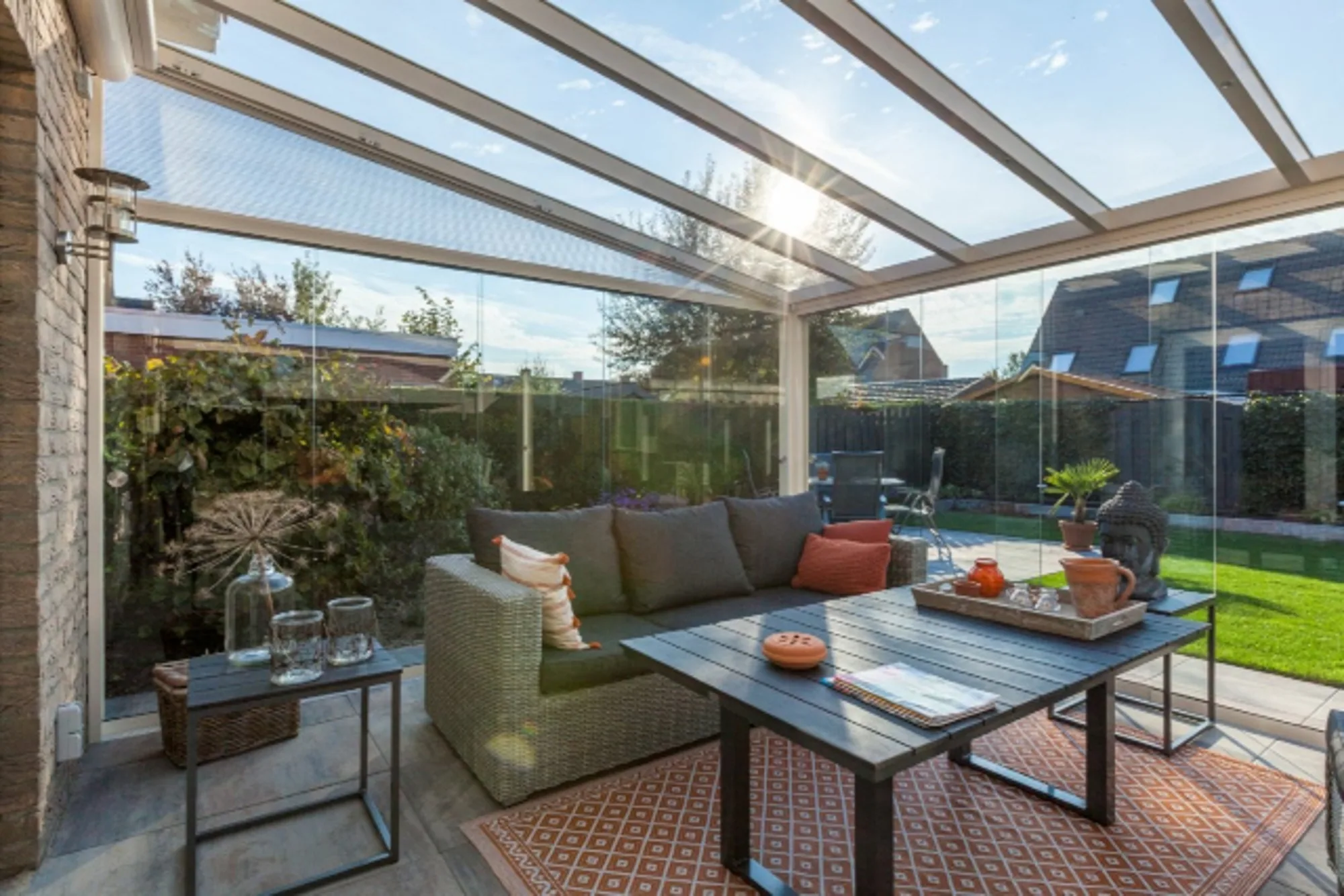
An open veranda is lovely in still summer weather. But the British climate being what it is, you will eventually find yourself sitting under a perfectly dry roof while wind drives rain sideways across your furniture. Side options solve that problem — and depending on which you choose, they can also add security, privacy, ventilation control, and genuine year-round usability to your outdoor space.
In this guide, we walk through all six side options we offer, explain what each one does well (and where it compromises), cover compatibility with every veranda model in our range, and give you honest pricing guidance. If you have already read our glass vs polycarbonate roof comparison, think of this as the natural next step — you have chosen your roof, now it is time to think about the walls.
Every side option we sell includes installation and VAT in the price. There are no hidden extras. And you do not have to decide now — all of our side options can be retrofitted to an existing veranda at any time.
The Six Side Options at a Glance
| Side Option | Best For | Guide Price |
|---|---|---|
| Sliding Glass Doors | Security, flexibility, year-round rooms | £4,000–£5,000+ |
| Fixed Glass Walls | Wind protection, max light, simplicity | £2,000–£3,500 |
| Aluminium Wall Panels | Total privacy, solid boundary | £1,500–£2,500 |
| Slide & Tilt Glass | Frameless views, ventilation, open-plan feel | £3,000–£4,500 |
| Polycarbonate Walls | Budget wind protection, translucent light | From £1,000 |
| Louvred Walls | Adjustable ventilation, privacy control | £2,500–£4,000 |
Now let us look at each one in detail.
1. Lockable Sliding Glass Doors
If you want to turn your veranda into a genuine room — one you can furnish, heat, and lock up when you leave — lockable sliding glass doors are the option that gets you there. These are full-height glass panels that slide smoothly along tracks, opening wide for summer and closing tight for winter.
The key feature is the multi-point locking system. When closed, the doors lock at multiple points along the frame, creating a secure seal that keeps weather out and valuables in. You can leave furniture, electronics, even a hot tub setup beneath your veranda without worrying about opportunistic access.
What they do well:
- Full security with multi-point locking — treat the space like an extension of your home
- Open or close to any width — one panel, two panels, or fully open
- Excellent wind and rain protection when closed
- Clear glass maintains full visibility and natural light
- Clean, modern aesthetic with slim aluminium frames
The trade-off: Sliding glass doors are the most expensive side option and have the most moving parts. They need occasional track cleaning and lubrication to keep running smoothly. The frames, while slim, are visible — if you want a completely frameless look, consider slide and tilt glass instead.
Guide price: £4,000–£5,000+ per span, including installation and VAT. Price varies with the width and number of panels.
2. Fixed Glass Walls
Sometimes the simplest solution is the best one. Fixed glass walls are exactly what they sound like — permanent panels of glass that close off a side of your veranda. No tracks, no hinges, no moving parts. Just glass, framed in aluminium, fixed in place.
The appeal is straightforward: maximum wind and rain protection with maximum light transmission. A fixed glass wall blocks the weather completely while preserving the open, connected feel that makes a veranda special. You still see your garden. Light still floods in. But the wind and rain stay outside where they belong.
What they do well:
- Complete wind and rain protection on the enclosed side
- No moving parts — nothing to maintain, nothing to break
- Maximum natural light and visibility
- Clean lines and a permanently neat appearance
- Lower cost than sliding or tilt systems
The trade-off: They do not open. If you want the ability to open a side completely on warm days, you need a sliding or tilt system. Fixed glass walls work best on the side of your veranda that faces the prevailing wind or an exposed aspect — the side you would never want open anyway.
Guide price: £2,000–£3,500 per span, including installation and VAT.
3. Aluminium Wall Panels
Not every side of a veranda needs to be transparent. If your veranda sits close to a neighbour’s boundary, overlooks a side passage, or faces an aspect you would rather screen off, aluminium wall panels give you a solid, permanent wall that matches the rest of your veranda perfectly.
These panels are powder-coated in the same colour as your veranda frame — typically anthracite grey (RAL 7016) — so they look like an intentional part of the structure rather than an afterthought. The result is a clean, finished appearance that provides total privacy and complete weather protection on that side.
What they do well:
- Total privacy — no visibility from the outside
- Complete weather protection, solid and draft-free
- Colour-matched to your veranda frame for a seamless look
- Zero maintenance — powder-coated aluminium does not rust, peel, or fade
- Ideal for mounting shelving, hooks, or wall-hung accessories on the inside
The trade-off: Obviously, you lose all natural light and visibility on that side. Aluminium walls work best as a complement to glass or open sides — closing off one boundary while keeping others open. Using aluminium on every side would create a box rather than a veranda.
Guide price: £1,500–£2,500 per span, including installation and VAT.
4. Slide & Tilt Glass
Slide and tilt glass is the most versatile side option in our range. Each panel can do three things: stay closed for full weather protection, tilt inward at the top for controlled ventilation while staying mostly sealed, or slide and stack to one side to open the entire span.
The panels are frameless — or very close to it — which gives you an uninterrupted glass wall when closed and a completely open space when stacked. The visual effect is striking: when the panels are shut, you get a near-seamless wall of glass. When they are open, they tuck away neatly so you barely notice them.
What they do well:
- Three positions: closed, tilted for ventilation, or fully open
- Frameless or near-frameless — the cleanest aesthetic of any glass option
- Panels stack neatly to one side when fully opened
- Tilt function allows ventilation even in light rain
- Transforms a veranda between enclosed room and open terrace in seconds
The trade-off: Slide and tilt systems are not lockable in the same way that sliding glass doors are. They provide a physical barrier and wind protection, but they do not offer the multi-point security locking of dedicated sliding doors. If security is your primary concern — protecting valuable furniture or equipment — lockable sliding glass doors are the better choice.
Guide price: £3,000–£4,500 per span, including installation and VAT.
Slide & tilt vs sliding glass — which to choose? If you want security and locking, go sliding glass. If you want frameless aesthetics and the tilt ventilation feature, go slide and tilt. Both provide excellent weather protection when closed. The choice comes down to whether you prioritise locking or looks.
5. Polycarbonate Walls
If you want wind and rain protection without the price tag of glass, polycarbonate walls are the most accessible option in our range. These translucent panels let diffused light through while blocking the elements — similar in principle to a polycarbonate veranda roof, but vertical.
Polycarbonate is significantly lighter than glass, which makes it easier and faster to install. It is also virtually unbreakable — it will not shatter if struck by a football, a blown branch, or an over-enthusiastic dog. For families with young children or active gardens, that resilience has genuine practical value.
If you are weighing up polycarbonate against glass more broadly, our glass vs polycarbonate comparison covers the material differences in depth — much of that logic applies to walls as well as roofs.
What they do well:
- Lowest cost side option — starting from around £1,000 per panel
- Translucent — lets diffused light through without full transparency
- Lightweight and virtually shatterproof
- Effective wind and rain barrier
- Some inherent privacy due to the translucent (not transparent) finish
The trade-off: Polycarbonate does not have the clarity or premium feel of glass. Views through polycarbonate are blurred rather than sharp. Over many years, polycarbonate can develop a slight haze or yellowing, though modern UV-stabilised panels resist this well. If aesthetics and clarity are important to you, glass is the better material — but if budget is the primary consideration, polycarbonate delivers solid performance at a significantly lower price.
Guide price: From £1,000 per panel, including installation and VAT.
6. Louvred Walls
Louvred walls are the only side option that gives you continuously adjustable control over both ventilation and privacy at the same time. The aluminium louvre blades tilt from fully closed (complete privacy, full weather protection) to fully open (maximum airflow and visibility), and you can set them anywhere in between.
Think of them as external venetian blinds, but solid, weatherproof, and built to last decades. When closed, they create a sealed wall that blocks wind, rain, and prying eyes. When open, air flows freely through the space and you regain your view. The ability to adjust moment by moment — more breeze on a warm afternoon, closed tight when the wind picks up — makes louvres uniquely responsive to British weather.
What they do well:
- Continuously adjustable — set the angle anywhere between open and closed
- Combined ventilation and privacy control in a single system
- Complete weather protection when fully closed
- Distinctive, contemporary aesthetic
- Powder-coated aluminium — no maintenance required
The trade-off: Even when fully open, louvre blades partially obstruct the view compared to glass. They do not offer the transparency of any glass option. The mechanical adjustment system, while robust, is an additional moving component that glass walls simply do not have. Louvres are best suited to customers who value airflow control and on-demand privacy above maximum visibility.
Guide price: £2,500–£4,000 per span, including installation and VAT.
Which Side Options Fit Which Veranda?
Not every side option is compatible with every veranda model. The table below shows which combinations work. If you are still choosing your veranda, this may influence your decision — or you can browse our full range starting with the Bolthole, our most affordable model.
| Veranda Model | Sliding Glass | Fixed Glass | Aluminium | Slide & Tilt | Polycarbonate | Louvred |
|---|---|---|---|---|---|---|
| Bolthole | ✓ | ✓ | ✓ | ✓ | ✓ | ✓ |
| Haven | ✓ | ✓ | ✓ | ✗ | ✓ | ✗ |
| Sanctuary | ✓ | ✓ | ✓ | ✓ | ✓ | ✓ |
| Pavilion | ✓ | ✓ | ✓ | ✗ | ✓ | ✗ |
| Horizon | ✓ | ✓ | ✓ | ✓ | ✓ | ✓ |
| Vista | ✓ | ✓ | ✓ | ✗ | ✓ | ✗ |
Why the difference? The Haven, Pavilion, and Vista are our British-engineered models. Their post and beam profiles are designed for sliding glass, fixed glass, aluminium, and polycarbonate — but the profile geometry does not accommodate the specific mounting requirements of slide-and-tilt or louvred systems. The Bolthole, Sanctuary, and Horizon use a different post profile that supports all six options.
You Do Not Have to Decide Now
This is one of the most common concerns we hear: “If I don’t order side options with my veranda, will I be stuck with an open structure?” The answer is no.
Every side option in our range is designed to be retrofitted. The mounting points are built into the veranda posts as standard. Whether you add sides on day one or three years later, the installation process is the same and the result is identical. There is no penalty for waiting.
In fact, many of our customers deliberately choose to live with their veranda open for a season before deciding what sides they want. A summer of actual use teaches you things that no brochure can — which direction the wind comes from, which side gets the afternoon sun, whether privacy from the neighbours matters more than you thought. Experiencing the space first and then enclosing it based on real knowledge is a perfectly sensible approach.
All of our veranda models come with the mounting points for side options built in. Adding sides later is not an afterthought — it is anticipated by the design. Order your veranda now, add sides whenever you are ready.
Mixing and Matching: The Smart Approach
Very few customers use the same side option on every face of their veranda. The most practical (and most popular) approach is to mix different types based on what each side of the structure actually needs.
Here are some combinations we install regularly:
- Sliding glass on the front + fixed glass on one side + aluminium panel on the neighbour side. This is our most common combination. The front opens for access and summer living, one side lets light in while blocking wind, and the aluminium panel creates a solid boundary where privacy matters.
- Slide and tilt on the front + louvred wall on the side. Maximum flexibility — the front opens completely or tilts for ventilation, while the louvres on the side give you adjustable airflow and privacy without committing to a fully transparent wall.
- Fixed glass on two sides + the front left open. If your veranda is in a sheltered position and you mainly need wind protection rather than security, two fixed glass walls can be enough to create a comfortable, sheltered space while keeping the front open to the garden.
- Polycarbonate on the windward side + nothing else. The budget-conscious approach. One polycarbonate panel on the side that catches the worst weather can transform the usability of a veranda for under £1,000.
There is no wrong combination. The right mix depends on your garden, your budget, and how you plan to use the space. We are always happy to talk through options — book a call or ring us on 0800 654 6964 and we will help you work out what makes sense for your setup.
Pricing Overview
Side option pricing depends on the type, the span width, and the veranda model. As a general guide:
| Side Option | Starting From | Typical Range |
|---|---|---|
| Polycarbonate Walls | £1,000 | £1,000–£1,800 |
| Aluminium Panels | £1,500 | £1,500–£2,500 |
| Fixed Glass Walls | £2,000 | £2,000–£3,500 |
| Louvred Walls | £2,500 | £2,500–£4,000 |
| Slide & Tilt Glass | £3,000 | £3,000–£4,500 |
| Sliding Glass Doors | £4,000 | £4,000–£5,000+ |
All prices include installation and VAT. For an exact price based on your veranda model and dimensions, use our online quoter — it gives you a real figure in under two minutes, no phone call required. For a broader look at what a complete veranda project costs, see our full pricing guide.
Ready to See What Side Options Would Cost for Your Veranda?
Our online quoter gives you an instant, real price — no phone call, no salesperson, no obligation.
Get an Instant Quote Book a Time to TalkFrequently Asked Questions
Can I add side options after my veranda is already installed?
Yes. All of our side options are designed to be retrofitted to an existing veranda. The mounting points are built into the veranda posts as standard, so there is no structural difference between adding sides at the time of installation or years later. Many customers live with an open veranda for a season to understand how they use the space before committing to side options.
Can I mix different side options on the same veranda?
Absolutely — and most customers do. The most popular combination is sliding glass on the front for access, fixed glass on one side for light, and an aluminium panel on the other for privacy. We can help you work out the right mix for your specific setup.
Which side option is best for wind protection?
Fixed glass walls and lockable sliding glass doors both provide excellent wind protection. If your primary concern is blocking wind while maintaining clear visibility, fixed glass is the simplest and most cost-effective choice. If you also want the ability to open the wall on calmer days, sliding glass gives you both.
Do side options require planning permission?
In the vast majority of cases, no. Veranda side options fall under the same permitted development rules as the veranda itself. Modern aluminium verandas very rarely require planning permission. We will always advise you if your specific installation is likely to need planning approval — see our planning permission guide for more detail.
How much do veranda side options cost?
Prices vary by type and size. Polycarbonate walls start from around £1,000 per panel, while lockable sliding glass doors can be £4,000–£5,000+ depending on the span. All prices include installation and VAT. Use our online quoter for an exact figure based on your veranda model and dimensions.